
One of these things is not like the other, one of these things just doesn’t belong!
Do you remember that song from Sesame Street? Here’s a refresher:
I want you to keep that song in mind (trust me, it will be in your head all day now!) as you read this post—it’s going to come up again at the end!
We’ve recently conducted a huge marriage study to see which things are associated with good marital outcomes.
We surveyed 1,300 matched pair couples, and another 5000 individuals, for our marriage study for our new book The Marriage You Want (here’s how to pre-order and join our launch team!)
We were asking, “if we wanted to give good marriage advice from the ground up, what would it look like?”
Our book is full of charts and graphs, but I want to talk today about how good things all tend to travel together, and bad things tend to travel together.
Here’s what I mean.
Basically, everything is correlated with everything else. If one thing gets better, chances are other things also get better. Likewise, if one thing gets worse, chances are other things also get worse. Good outcomes in one area tend to lead to good outcomes in other areas, and bad outcomes in one area tends to bring down satisfaction in other areas.
Makes sense, right?
One of the things that’s hard to do in studies like ours is tease out causation versus correlation.
Just because something is correlated with something else doesn’t mean it causes it.
Here’s an example from my husband’s pediatric practice. It’s been well known in the literature that families that eat together at least three times a week fare far better on many outcome measures than families that don’t. The kids are more likely to get straight As. They are less likely to use drugs or alcohol. Far less likely to get pregnant or end up in jail. Even less likely to have mental health issues.
Does eating together stop girls from getting pregnant?
No, the causation doesn’t work that way.
But if you’re the kind of family who eats together three times a week or more, you’re also the kind of family that exhibits other traits that make these things less likely. Plus you talk together at least three times a week. Parents know what is going on in the kids’ lives. Siblings talk to each other. Etc. etc.
So even though eating together doesn’t stop pregnancy, if you start eating together, you become the kind of family that does things that leads to girls not having unprotected sex.
It’s complicated, I know.
(Incidentally, one of the ways to tease out causation is to figure out which came first when you’re looking at outcomes. We were able to do that a little bit in our study for She Deserves Better, because we asked about two different time periods in a woman’s life—when she was a teen and when she was an adult. Still not perfect for many reasons, but it helps).
Let’s get back to marriage outcomes.
We looked at a whole package of marriage outcomes that are good—things like:
my spouse knows how to make me laugh
I’m frequently aroused during sex
I can share my weaknesses with my spouse
I feel like my opinions matter in our marriage as much as my spouse’s do
My spouse doesn’t have explosive anger
My spouse isn’t passive aggressive
My spouse does his/her fair share of housework
I feel like I can be myself with my spouse
I don’t have low libido
We have shared hobbies
When we’re having a disagreement, my spouse takes pains to understand my point of view, even if he/she doesn’t agree
And I could go on and on.
But here’s the thing:
When one of these things is doing well, all of the other ones tend to do well too.
Here’s what that looks like in The Marriage You Want:
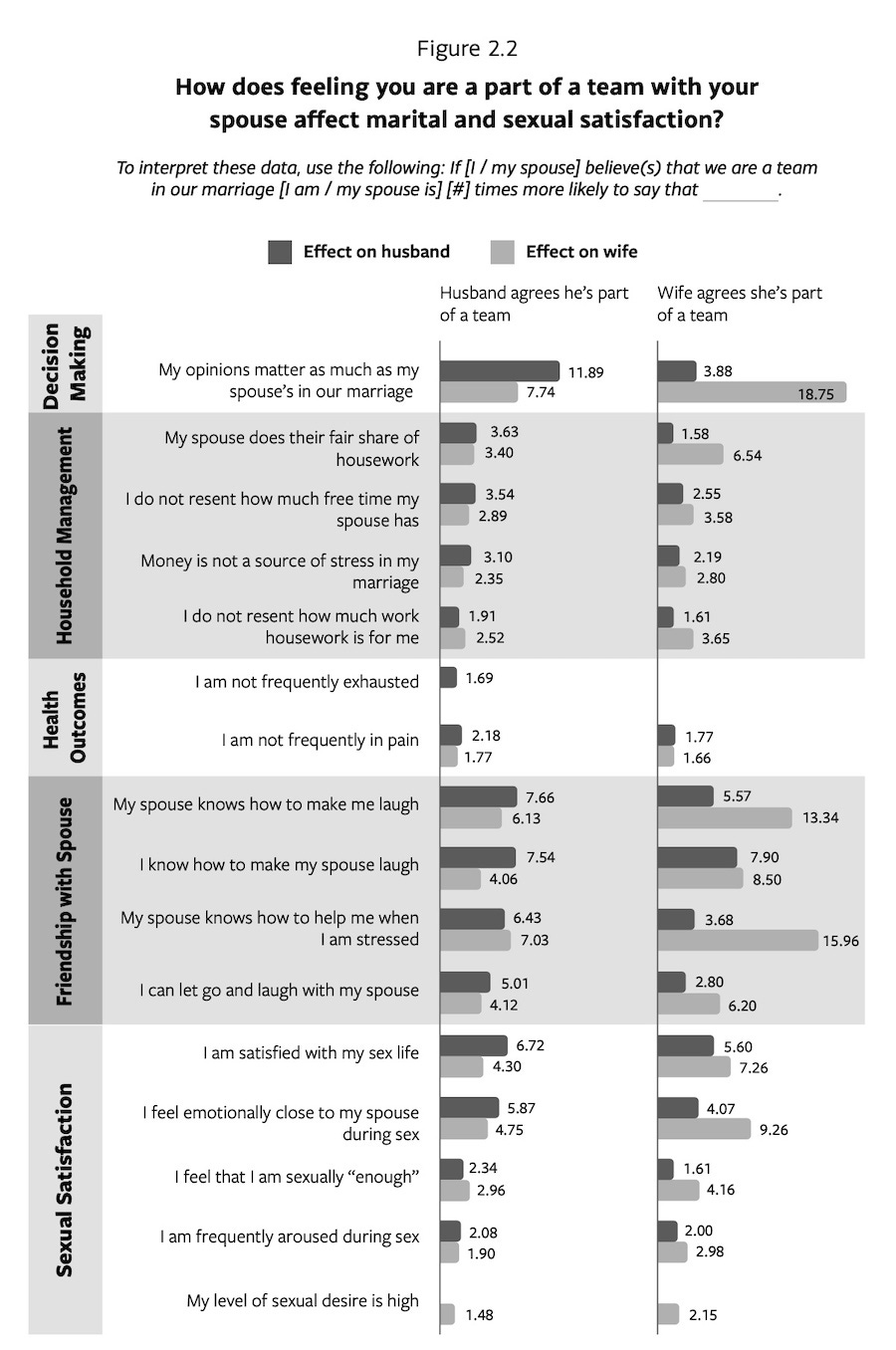
So when you believe that you’re part of a team with your spouse, all of these other good outcomes are more likely to happen.
For instance, when she feels like she’s a team with her husband:
She is 15.96 times more likely to say “my spouse knows how to help me when I’m stressed”
She is 9.26 times more likely to say “I feel emotionally close during sex”
He is 4.07 times more likely to say “I feel emotionally close during sex”
When he feels like he’s part of a team with his wife:
He is 6.72 times more likely to say “I am satisfied with my sex life.”
She is 4.06 times more likely to say “I know how to make my spouse laugh.”
She is 1.48 times more likely to say “my level of sexual desire is high.”
Good marital outcomes tend to travel together, and bad marital outcomes tend to travel together.
We have other charts in the book that show that bad things also go together—if he has the tie-breaking vote, that leads to bad things. If the mental load isn’t shared, that leads to bad things in other areas too.
I explained it this way on our Bare Marriage podcast yesterday (episode 267).
Imagine you have two groups of people who are going hiking—one who is wearing all purple t-shirts, and one who is wearing all green t-shirts. They start out at the same place, but they go in different directions.
The purple t-shirts are good outcomes, and the green t-shirts are bad outcomes. But they travel together. When one person goes ahead, the whole group tends to follow.
Now, as you notice from that chart above, some things move more closely than other things. You get a 1.48 times change in sexual desire levels, but an 18.75 times change in feeling like your opinions are being heard.
So picture it like this. In any hiking group, some people are holding hands and sticking super close together, while other people are lagging behind, or are simply at the outer edge of the group. It may look like this:
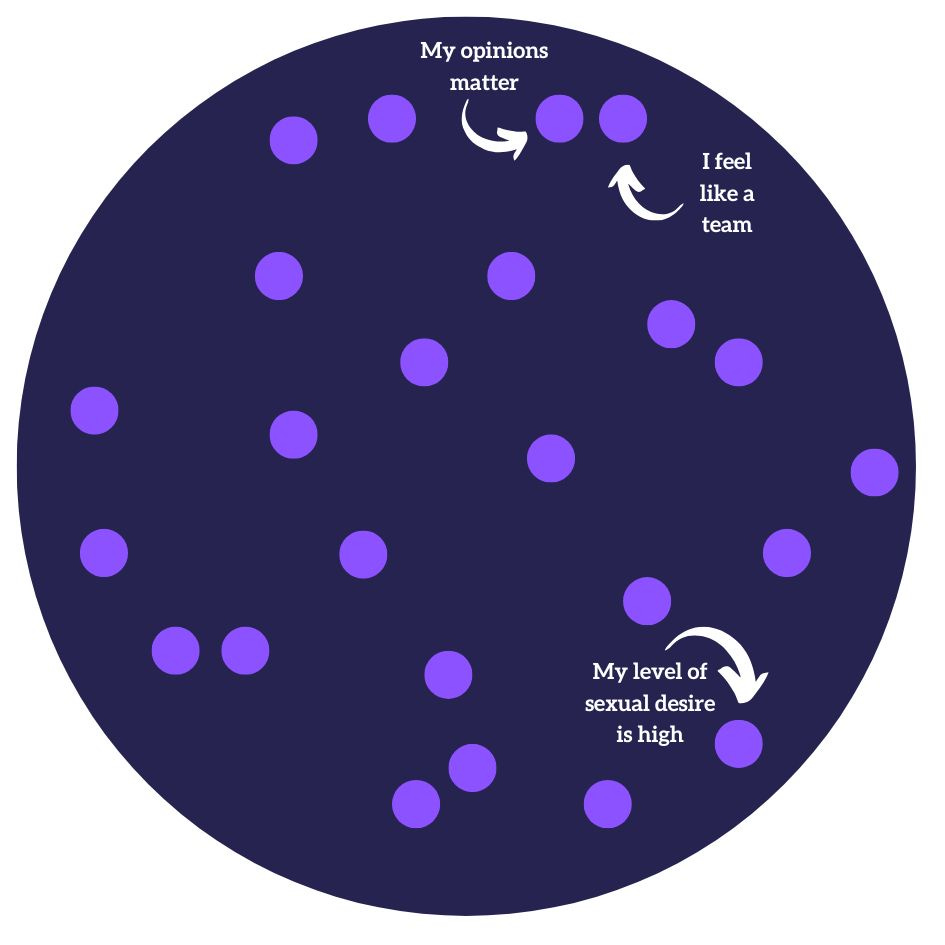
So when “I feel like a team” jumps forward, “my opinions matter” is right there with them! They’re super closely related. But the sexual desire one may not move as quickly or stay as close—but it is still going in the same direction.
(Science nerds are likely shuddering right now and adding tons of caveats to what I’ve said, but I’m just trying to explain this in as simple a way as possible, so forgive me for oversimplifying!)
So we have a package of good things, and a package of bad things, and they tend to move in the same direction, even if they don’t all move at the same rate.
Makes sense, right?
Now, get ready, because you’re going to be humming the song again in a minute.
Complementarianism, and its proxies, are part of the bad group.
Complementarianism is the belief that men are in authority over women in marriage, and that men and women have different roles. He’s to lead; she’s to submit. He makes the final decision and has the tie breaking vote in the case that they can’t come to an agreement in an argument.
And, often, he needs respect in a way that she can never understand.
We measured these things too. We measured:
What happens when you believe when you get married that he has the tie breaking vote?
What happens if, when you have a disagreement, he’s the one that breaks that tie?
What happens if you believe that he needs respect in a way that she doesn’t understand?
And these things move with the bad group, not with the good group.
When he has a tie breaking vote, it affects that whole package of bad outcomes. Some of them are so far on the edge of the circle that they’re not statistically significant (like with everything we measure), but it affects a whole lot of them. And when it affects something, it moves in the bad direction.
Okay, now’s the time to start humming!
Complementarians say, “God put men in authority so that they could lay down their lives and live sacrificially for their wives, and they do it for the benefit of their wives”, they’re wrong. It’s like thinking you can have a green hiker in the purple hiker group, and it doesn’t work.
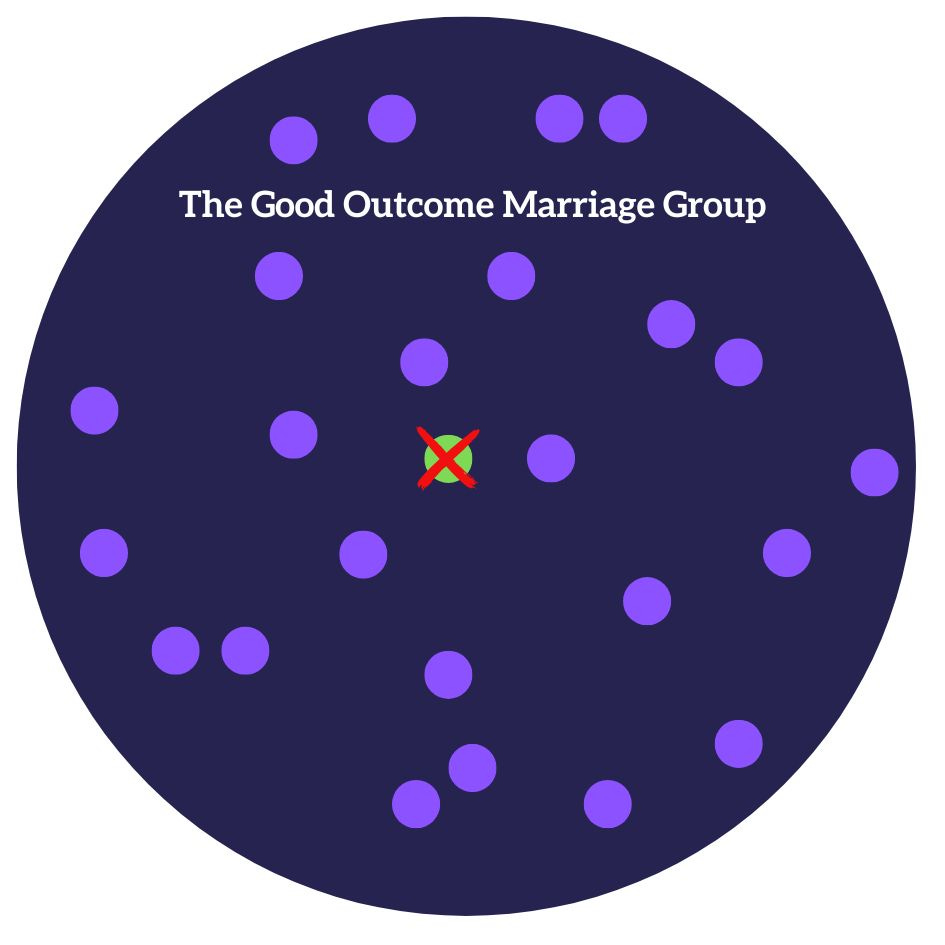
The green guy doesn’t belong here! The green guy belongs with the green hikers, with bad marriage outcomes.
Get it?
Complementarians claim that their doctrine produces the best marriages, but it’s actually the opposite.
Teamwork, and valuing each other’s opinions, and not having one in authority over the other produces good outcomes. Hierarchy produces bad outcomes.
It’s as simple as that.
Now, people will argue that “but the Bible says complementarianism is true!”
I know that’s what many people have been taught. But please understand, that is one interpretation of the Bible, but it is not the only one, or even the most accepted one. Among those who have studied Greek and Hebrew, and who have studied New Testament history, a majority believe in egalitarianism, not complementarianism.
And what does Jesus say we are to do when we are wondering if someone is a false teacher? He tells us in Matthew 7:15-20 to judge the fruit.
Well, here it is. We have a purple (good) group and a green (bad) group. One group is full of good fruit, and one group is full of bad fruit. The good fruit side is teamwork; the bad fruit side is hierarchy.
Take Jesus at His word.
Judge the fruit.
Because one of these things is not like the other!

Preorder The Marriage You Want to see more of our amazing charts and graphs, and to see what goes into a marriage that works—rather than a marriage that’s a hard slog!
And find out about our launch team and pre-order bonuses!
For more on complementarianism (and I’ve written so much), please see:
Our podcast on the Danvers Statement (4 ways complementarianism can go wrong)
Our podcast asking, “Are We Making a Strawman out of Complementarianism?”
Our reply to Nancy Pearcey on why complementarian marriages do not do best
It should be common sense that having equal respect and dignity in marriage leads to good outcomes, but I am amazed by people who fall for a strict marital hierarchy. Just by examining couples that I have known in life, power difference tends to lead to bad outcomes. The data is not surprising to me for this reason.
“The Green guy doesn’t belong here!” 😆 This is all fascinating. Thanks for putting this together.